St. Thomas's Doubt in the Hymns of the Byzantine Rite
Updated: Jun 26

I recently watched a YouTube video on the French-language channel “Melanchromia" in which the host gave an analysis of Caravaggio’s famous rendition of the Incredulity of St. Thomas. This piqued my interest because in recent years, as my family and I became regular attendees of our Melkite parish in the SF Bay Area, I have grown in my understanding of the Church’s interpretation of this biblical passage as conveyed by the liturgical texts and hymns of the Byzantine rite.
The dialogue between Thomas and Jesus in the upper room has clearly stimulated a great deal of theological and cultural interest over the centuries. As the historian Joyce Salisbury put it a few years ago:
The first central mystery of Christian faith is the Resurrection of Jesus after his crucifixion. A second mystery is how people can believe in the first mystery. The account of the doubts of the apostle Thomas in the Gospel of John highlights the intersection of these two mysteries.
That is a quote from a review of a book by another historian, Glen Most, dedicated to the varied and controversial interpretations of the story of St. Thomas in theology, art, and culture throughout the centuries.
How the world sees it
The controversies arose in large part because the biblical text does not explicitly state whether the apostle did in fact probe his finger into Christ’s wounds or whether he refrained or recoiled from doing so. Depending on what one reads into that silent passage, which leads to Thomas’s ensuing confession of faith (“My Lord and my God!”), the apostle could be claimed at various times as a gnostic saint (if he recoiled from touching the evil, material body) who would later produce his own gospel, as a biblical witness to the Protestant doctrine of sola fide (if he had no need for sacramental touching), or as a proto-modern skeptic not satisfied with blind faith but demanding verification for any belief.
The latter take is the one emphasized in the video. The apostle is allegedly uniquely skeptical of the news of Jesus’s Resurrection. The video commentator proposed that Caravaggio was already expressing the empiricist mood of the modern age. Accordingly, by actually putting his finger in the wounds of Christ, Thomas points to the scientific revolution to come. As a major artistic figure of the Renaissance, Caravaggio supposedly shows man as no longer satisfied with faith but needing to test every claim or “hypothesis” presented to him.
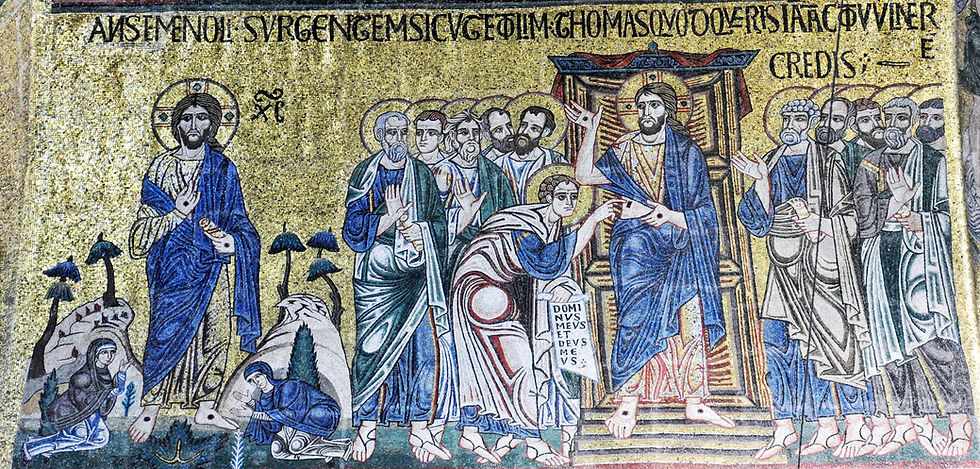
What the Church teaches
Regarding the touching, The church's interpretation of the passage offered in the hymnography of the Byzantine liturgy is quite unambiguous. Take for example, this sticheron from the vesper service:
O Christ, when You came and stood before Your disciples, even though they had locked the doors, Thomas the Twin was not with them. Thus he doubted what he was told, in order to turn the steps of unbelievers toward the faith. In Your goodness, You did not reject him, but rather strengthened him by showing him the wounds in Your spotless side, hands, and feet. Touching them, and having seen You, he confessed that You are neither an abstract God nor a simple man, crying out “My Lord and my God, glory to you!”
Or, the final sentence of the Lete.
Having been assured of your humanity and divinity by his own hand, the disciple was filled with awe and cried out in an act of faith, "my Lord and my God, glory to you!”
Or, this beautiful passage from the aposticha of vespers:
What a wondrous mystery: that grass can touch fire, and not be consumed; for Thomas put his hand into the fire of the side of Jesus Christ, our God, and he was not consumed in touching Him. He changed his doubt into the fervor of faith, and shouted from the depth of his heart, "O Master who are risen from the dead, you are my God! Glory to you!”
We see from the first passage quoted, and from other similar ones, that the saint’s attitude, action, and response is a source of great joy as it helps “turn the steps of unbelievers toward the faith.”
Contrary to the common view and to his portrayal in the video, Thomas was not unique in his doubting. The other apostles, too, disbelieved the good news reported by Mary Magdalene and the women disciples who had first seen the risen Christ. They, also, wanted to see for themselves. But the saint dared put his doubt to the test, and was thereby strengthened in his faith.
There is nothing shameful about doubting the extraordinary event of the Resurrection. On the contrary, it is quite natural. Thomas speaks for all of us, who inevitably harbor a mixture of belief and unbelief (Mk 9:24), but he leads the way in allowing us to put our faith to the test. Ironically, in a secular age in which science is a quasi religion, many unbelievers today refuse to test the good news, preferring instead to stay on the sidelines and remain in a comfortable state of agnosticism, either to conform to cultural pressure or out of a subconscious fear of discovering the Truth.
Of course, we don't have the opportunity to do as Thomas did and place our fingers in the wounds of God. But the Church today continues to demand tangible evidence for all supernatural claims which all point to the truth of the faith and the Resurrection. And there are many! Think of the Marian Apparitions at Fatima or Zeytoun, or the miraculous works of some recent saints, such as Padre Pio or St. Charbel, or the inexplicable features of the Shroud of Turin, or the verified Eucharistic miracles, and on and on. All miraculous claims that capture the devotion of the faithful are placed under rigorous forensic testing before being deemed worthy of belief. Ours is not a blind faith, on the contrary, it is a faith that demands and obtains evidence.
And St. Thomas shows the way to it. He is celebrated in the Eastern churches of the Byzantine rite on the Sunday that follows Easter Sunday (the “Sunday of St. Thomas”) as representative of all Christian believers.

PS: the Byzantine icons that illustrate the same passage of the Gospel of John also clearly show Thomas touching the wounds or side of Christ. Tellingly, though, the icons are not named after the saint's doubt or incredulity. Rather, they often go under the name of "The Assurance of St. Thomas" or "The Touching of St. Thomas."
Comments